A capable leader rarely comes apart all at once.
The unraveling is quieter than that. It begins in small internal movements that are easy to miss, because the outer structure still appears intact. The meetings continue. The decisions are made. The role is performed with enough competence that almost nobody notices what has begun to shift beneath the surface.
Leadership Drift is the gradual movement away from conscious, calibrated leadership under sustained pressure.
Gradual
Drift rarely announces itself. It accumulates through small shifts, each one individually explainable and collectively consequential. A reflective pause skipped because the day is full. A repair deferred because there are more urgent matters. A decision pulled back because the stakes feel high.
Movement
Drift is not a personality type or a permanent condition. It is movement away from centre, away from range, away from the ability to hold complexity without collapsing into a familiar default. Because it is movement, it can be seen. Because it can be seen, it can be reversed.
Calibrated
Senior leadership is rarely a choice between an obviously good and an obviously bad response. It is the work of holding tensions that do not resolve neatly. Under pressure, that calibration begins to fail. The leader does not lose capacity so much as range.
It does not arrive looking like failure. It arrives looking like pressure.
A difficult quarter. A demanding board. A restructuring. An impossible timeline. The explanation is reasonable, and the pressure is real. What goes unnoticed is the secondary movement: the leader is not only responding to pressure, but being changed by it.
- 01
Your replies grew shorter. Each instance was defensible. You were under pressure, and you were entitled to be brief.
- 02
Questions that used to be curious became checks.
- 03
Work you had delegated started coming back to your desk for review, quietly, without announcement.
- 04
Warmth became procedural. Present in your words, absent from your attention.
- 05
The room began to agree with you quickly. Papers arrive pre-aligned.
- 06
Bad news arrives late, softened, or already attached to a solution.
You have started reading their carefulness as passivity. The harder possibility is that they are responding, with great accuracy, to something that changed in you first.
There is a particular cruelty in how drift operates among high performers.
The more capable a leader is, the longer they can hide the cost of drift, including from themselves.
Competence keeps the surface intact. The leader continues to deliver, remains articulate in meetings, decides quickly enough, maintains the professional front. Internally, the effort required to hold that standard has increased. Recovery is slower. Patience is thinner. Attention is more fragmented. The space between stimulus and response has narrowed.
Because the output still appears acceptable, no urgent signal arrives to stop and examine what is happening. Worse, the organisation often rewards the compensation.
- The leader who is over-functioning is praised for commitment.
- The leader who is controlling is praised for ownership.
- The leader who is always available is praised for dedication.
- The leader who performs certainty is praised for executive presence.
Behaviours that are signs of drift get reinforced by systems that value visible composure over internal coherence. This is how capable leaders drift further than others before anyone intervenes.
Request a free assessment →A leader's drift does not stay private.
It enters the room before they speak. It shapes what people bring, what they withhold, how safe they feel, how much initiative they take, and how honestly they engage with the work. A narrowed leader creates a narrowed field, and a narrowed field produces poorer information and weaker judgment.
Trust in the person closest to the work is falling fastest.
of leaders express trust in their immediate manager, down from 46% three years earlier. DDI, Global Leadership Forecast 2025. Approx. 13,000 leaders worldwide.
Silence upward is close to universal, and it is not rare or exceptional.
of professionals said they had at some point felt unable to raise an issue of concern with someone above them. Milliken, Morrison and Hewlin, New York University.
People go quiet from futility more than from fear.
Employees withhold the truth less out of fear of punishment than from a quieter calculation that speaking up will change nothing. Detert and Burris, Harvard Business Review.
The leader senses the withdrawal, reads it as the team's problem, and applies more pressure, which produces more careful behaviour. Drift removes the honest feedback that would have revealed it, then presents the silence as evidence that the team is the issue.
Request a free assessment →Every leader drifts. The measure of maturity is the consciousness and speed of return.
A leader's range narrows under sustained stress, poor recovery, unresolved conflict and exhaustion. It also widens, through awareness, regulation, practice and the disciplined work of recovery. The relevant question was never whether drift occurred. It is how long it lasted, how much accumulated before it was noticed, and how consciously the leader came back.
Awareness
How clearly a leader sees their own drift while it is still happening, rather than months later when the cost has already spread through the team.
Recovery
How quickly and intentionally a leader returns after disruption. A leader who drifts and returns quickly leaves little residue. A leader who drifts for months reorganises the system around a narrowed state.
Calibration
Reading what the moment actually asks for, and holding tension without collapsing into the response that is most familiar, most rewarded, or most psychologically safe.
Once a leader can see the drift, the drift is no longer fully in charge.
Request a free assessment →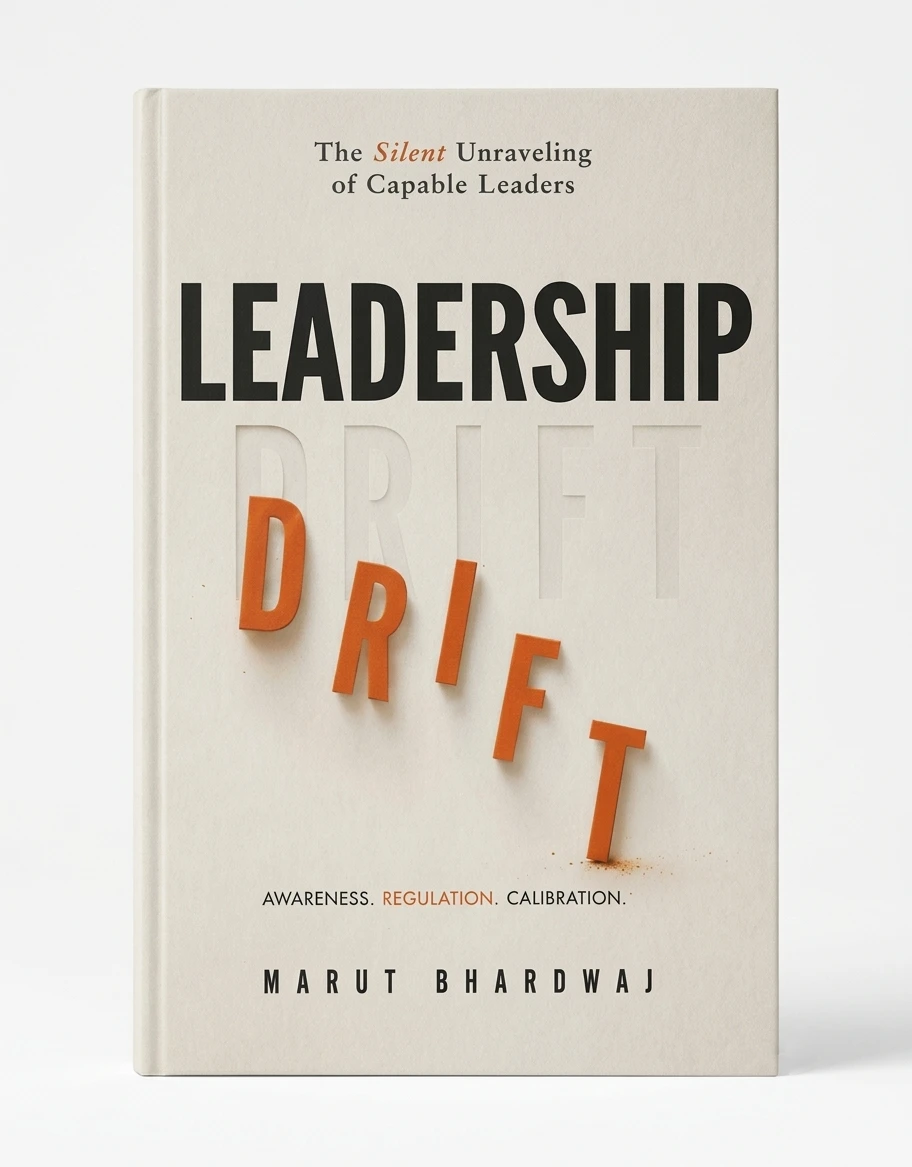
Leadership Drift
Written for leaders who are still performing but no longer fully present. Still deciding, but with less perspective. Still communicating, but with less generosity. Still trusted by title, while quietly losing the trust that comes from others feeling safe, seen and invited into honesty.
It names the problem, makes drift recognisable, and turns insight into practice. The aim is not to finish with a set of interesting ideas. It is to leave with a working map of your own drift, and a practical system for returning from it.
Most leaders have never been asked, with any precision, how they drift under pressure.
A short, confidential assessment for senior leaders and executive teams. Request it below and we will be in touch personally.
- Confidential by default. Results go to you, not to your organisation.
- Built for executive schedules, not for HR files.
- No competency grades and no personality label.
- Available for individual leaders and for intact leadership teams.
Marut Bhardwaj
Author · Leadership facilitator
Marut Bhardwaj has spent years in the room with senior leaders, and wrote Leadership Drift because the difficulty those leaders carry is so often misunderstood, including by them. They are rarely careless or weak, and they have not suddenly forgotten what they know. More often they are deeply committed and highly capable people, working in conditions more demanding than most around them fully understand, losing access to their own best leadership under sustained pressure.
His work brings together executive practice, behavioural science and reflective inquiry. It is intellectually rigorous without being academic, emotionally intelligent without being therapeutic, and written on the conviction that return is possible.